Have you ever opened a text and wondered what a short abbreviation meant? You might see “w/” in a message and think it is a typo.
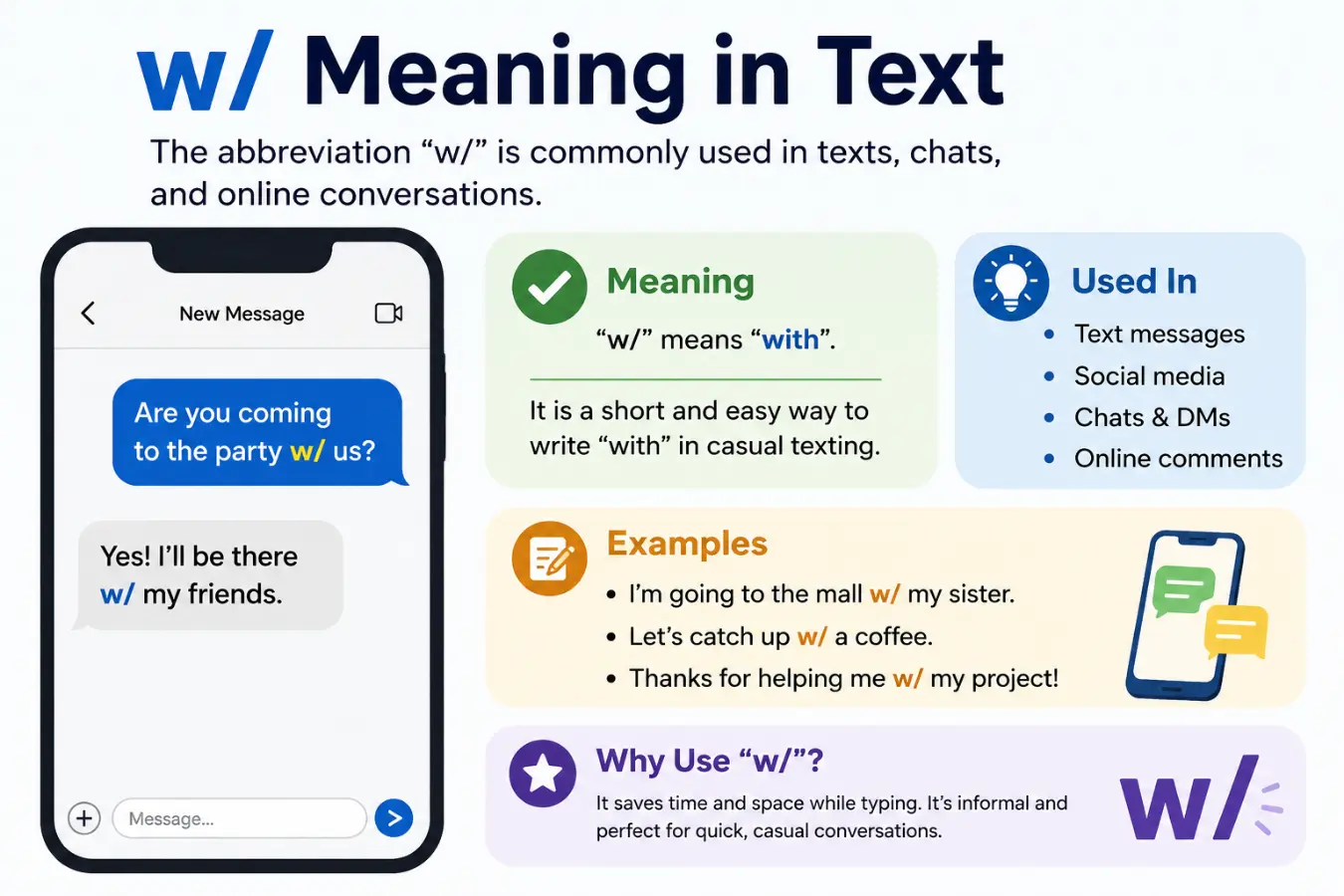
In reality, it is a common shorthand used in texting, notes, social media, and online conversations. The abbreviation w/ usually means “with.” People use it to save time and space when typing.
It is especially common in casual messages and quick notes. For example, someone might text, “I’m going w/ Sarah” instead of “I’m going with Sarah.” Once you know the meaning, w/ is easy to understand. Let’s look at how people use it and when it is appropriate.
What Does W/ Meaning in Text Mean?
“W/” means “with” in text messages and online communication.
It is a shortened form of the word with. People mainly use it because it is faster to type.
For example:
“Coming w/ you.”
This means:
“Coming with you.”
The abbreviation does not usually change the meaning of the sentence. It simply makes the message shorter.
Quick Meaning
- W/ = With
- Full word: With
- Type: Abbreviation or shorthand
- Tone: Casual and informal
- Common use: Texting, notes, social media, and online chats
You may also see w/ followed by a word, name, or phrase.
For example:
- “Coffee w/ Mom”
- “Going w/ friends”
- “Pizza w/ extra cheese”
- “Meeting w/ the team”
In each example, w/ means with.
Does W/ Have Other Meanings?
In most texting situations, w/ clearly means with.
However, context always matters. Some abbreviations can have different meanings online, but w/ is most commonly understood as “with.”
There is also “w/o,” which commonly means “without.”
Where Is W/ Used?
People use w/ in many forms of informal communication.
You may see it in:
- Text messages
- Instagram captions
- Snapchat messages
- TikTok comments
- Facebook posts
- WhatsApp chats
- Discord conversations
- Online forums
- Personal notes
- Shopping lists
- Quick reminders
It is not limited to teenagers. Adults also use w/ when writing quickly.
For example, someone might write:
“Dinner w/ family tonight.”
A student might write:
“Study w/ Ali at 6.”
A friend could send:
“Want to come w/ us?”
The abbreviation is especially useful when someone wants to keep a message short.
However, w/ is more appropriate for casual communication than formal writing.
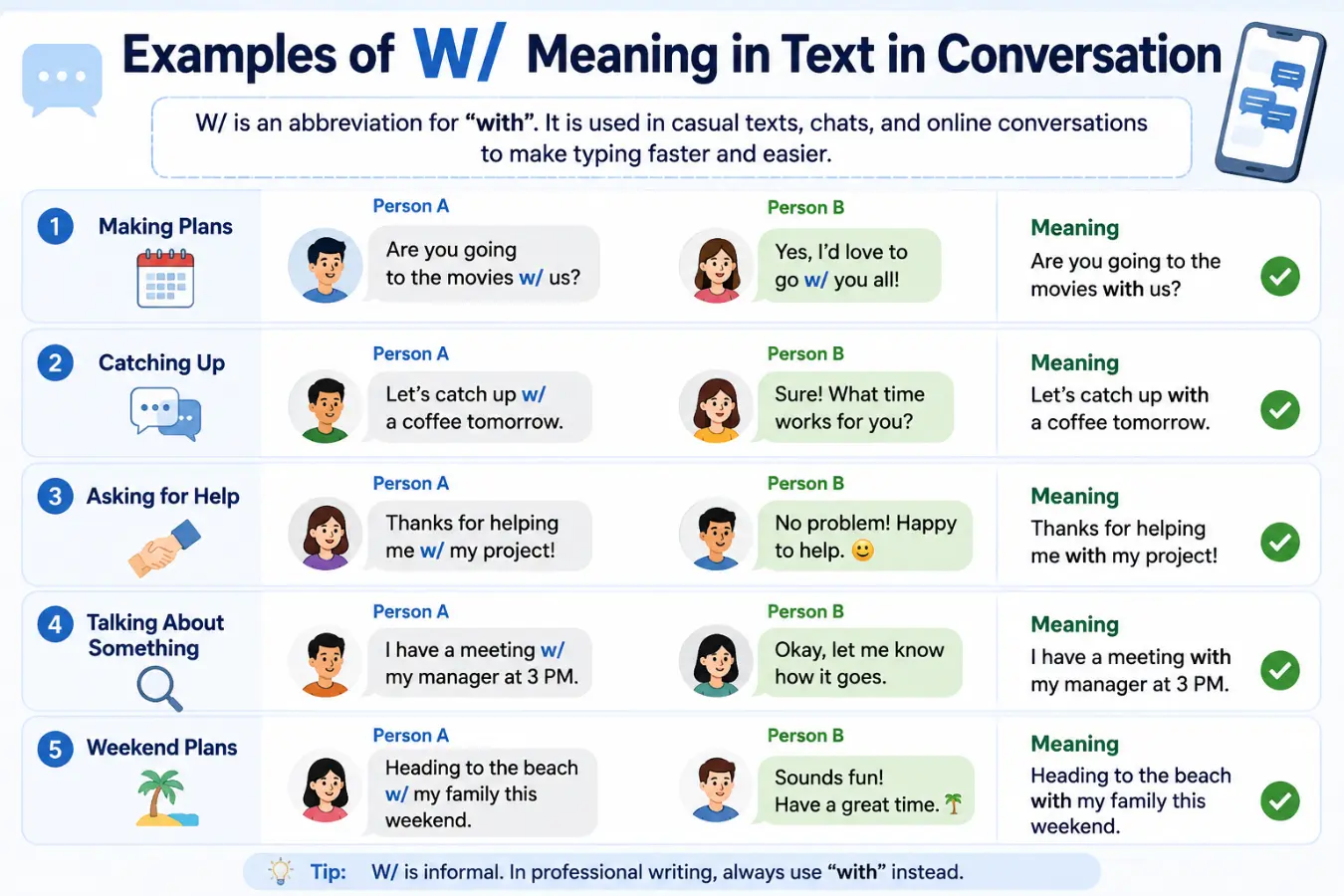
Examples of W/ Meaning in Text in Conversation
Here are some realistic examples showing how w/ can appear in everyday chats.
1. Friendly Conversation
Alex: What are you doing tonight?
Sam: Going w/ my cousins.
Here, w/ means “with.”
2. Making Plans
Mia: Are you coming to the party?
Lena: Yeah, I’m coming w/ Sarah.
The message means that Lena is coming with Sarah.
3. Casual Texting
Tom: Want coffee?
Jake: Sure, w/ extra sugar 😂
Here, w/ means “with extra sugar.”
4. Flirty Conversation
Emma: Movie tonight?
Ryan: Only if I can go w/ you 😉
The abbreviation itself is not flirty. The context and emoji create the playful tone.
5. Family Conversation
Mom: Where are you going?
Daughter: Shopping w/ my sister.
Again, w/ simply means “with.”
6. Funny Example
Ben: What did you order?
Chris: A burger w/ everything on it. I’m starving 😂
The abbreviation keeps the casual message short.
7. Social Media Caption
“Weekend trip w/ my favorite people ❤️”
Here, w/ means “with my favorite people.”
When to Use and When Not to Use W/
Knowing what w/ means is easy. Knowing when to use it is just as important.
When You Can Use W/
Use w/ when you are communicating casually with people who understand common shorthand.
Good situations include:
- Texting friends
- Messaging family
- Casual group chats
- Social media posts
- Informal comments
- Personal notes
- Quick reminders
For example:
“Lunch w/ the girls today!”
This sounds natural in a casual setting.
When You Should Avoid W/
Avoid w/ in formal or professional writing.
For example, instead of:
“I’ll meet w/ the manager tomorrow.”
Write:
“I’ll meet with the manager tomorrow.”
You should generally spell out with in:
- School assignments
- Academic essays
- Job applications
- Business emails
- Formal reports
- Official documents
- Professional presentations
The abbreviation is understandable, but it can make formal writing look less polished.
Is W/ Rude?
No. W/ is not normally rude or offensive.
It is simply shorthand for “with.”
Still, using abbreviations in the wrong situation can appear overly casual. The important thing is to match your writing style to your audience.
Is W/ Different From “With”?
The meaning is the same, but the style is different.
| Form | Meaning | Style |
|---|---|---|
| w/ | With | Informal |
| with | With | Standard |
| w/o | Without | Informal |
| + | And/with, depending on context | Very casual |
For example:
Casual:
“Dinner w/ John?”
Standard:
“Dinner with John?”
Both sentences communicate the same basic idea.
The main difference is that w/ saves typing space.
Similar Slang Words or Alternatives
Several other abbreviations appear frequently in text conversations.
1. W/O
W/O usually means “without.”
Example:
“Coffee w/o sugar.”
Meaning:
“Coffee without sugar.”
2. BRB
BRB means “be right back.”
Example:
“BRB, getting some water.”
3. BTW
BTW means “by the way.”
Example:
“BTW, are you coming tonight?”
4. IDK
IDK means “I don’t know.”
Example:
“IDK what time they’re arriving.”
5. TTYL
TTYL means “talk to you later.”
Example:
“I have to go. TTYL!”
Unlike w/, these abbreviations represent phrases rather than a single shortened word.
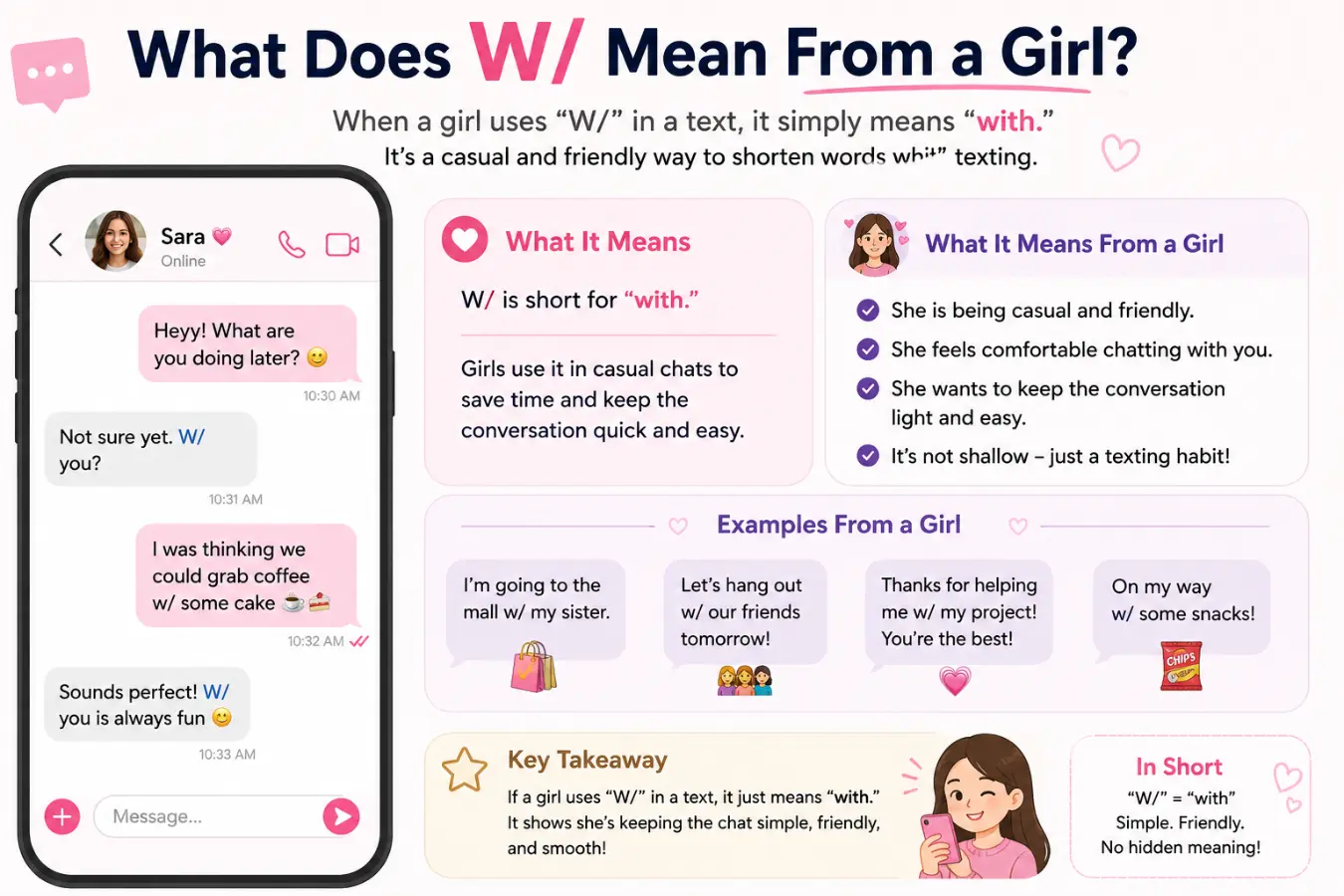
What Does W/ Mean From a Girl?
If a girl uses w/ in a text, it normally means exactly the same thing: “with.”
For example:
“I’m going w/ my friends.”
It does not automatically have a romantic or hidden meaning.
The surrounding conversation determines the tone. If she says:
“I want to hang out w/ you ❤️”
the message may sound affectionate, but w/ itself is not flirty.
Is W/ Still Popular?
Yes, w/ remains recognizable and useful in informal writing.
It is not necessarily trendy slang in the same way as newer internet expressions. Instead, it is a long-standing shorthand that people continue to use for convenience.
You may especially notice it in:
- Quick texts
- Notes
- Captions
- Messages
- Lists
- Informal online communication
Its popularity can vary by person and platform.
Can I Use W/ in Professional Chats?
It is better to avoid w/ in professional communication unless your workplace uses very casual messaging.
For example, use:
“I’ll speak with the client tomorrow.”
instead of:
“I’ll speak w/ the client tomorrow.”
The full word looks clearer and more professional.
In a casual workplace chat, however, w/ may be understood without any problem.
Does W/ Have a Flirty Meaning?
No, “w/” does not have a specific flirty meaning.
It simply means “with.”
A message can become flirty because of its words, context, punctuation, or emojis.
For example:
“Want to go w/ me? 😉”
The wink can make the message sound flirty. The abbreviation w/ does not create that meaning by itself.
FAQs:
What does w/ mean in text?
W/ is a common abbreviation for “with.” It is mainly used in casual texting and online communication.
Is w/ slang or an abbreviation?
It is best described as shorthand or an abbreviation for “with.” People commonly use it to type faster.
Is w/ rude?
No. W/ is not rude or offensive. However, it may look too casual in formal writing.
Can I use w/ in school or work?
You can use it in casual chats, but avoid it in formal assignments, reports, and professional emails. Spell out “with” instead.
Does w/ mean something flirty?
No. W/ simply means “with.” Any romantic meaning comes from the surrounding message, not the abbreviation itself.
Conclusion
So, what does w/ mean in text? In most cases, it simply means “with.” People use this shorthand in text messages, social media, captions, notes, and casual online conversations. It helps make messages shorter and quicker to type. The abbreviation is not rude or inherently flirty. However, it is informal, so you should avoid it in formal school or professional writing. When you see w/ in a message, replace it mentally with “with,” and the meaning should become clear. The easiest tip is simple: use w/ with friends and in casual chats, but write “with” when you want your message to sound professional.

Rubab Fatima is a passionate content writer and researcher with a strong interest in meanings, symbolism, language, and educational topics. She enjoys creating clear, informative, and engaging content that helps readers better understand words, concepts, and their deeper significance. Through her work at MeaningMindz.com, Rubab focuses on delivering well-researched articles that are both accurate and easy to read. Her goal is to make learning enjoyable while providing valuable insights that readers can trust.



1 thought on “W Meaning in Text: Complete Guide to This Popular Slang”