Have you ever opened a text and seen someone say, “Stop the cap”? You may have wondered what they meant. At first, “cap” sounds like something you wear on your head. However, online slang gives this simple word a completely different meaning. In texting and social media, cap usually means a lie, exaggeration, or something that is not true. You may also see people say “no cap,” which means “I’m being honest” or “I’m not lying.” This slang is common in casual online conversations. Let’s explore the cap meaning slang, where people use it, and how you can understand it in real chats.
What Does Cap Mean in Text?
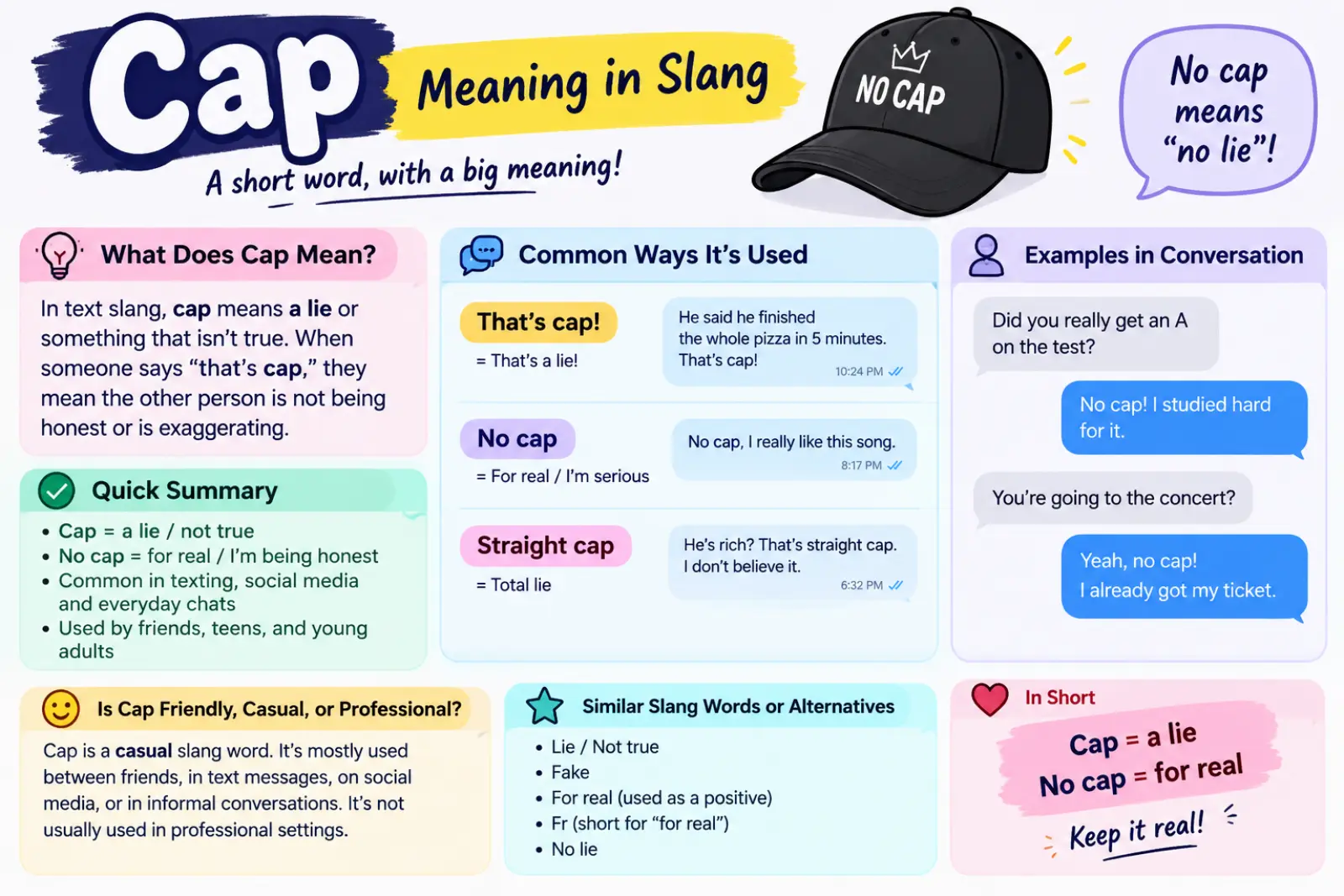
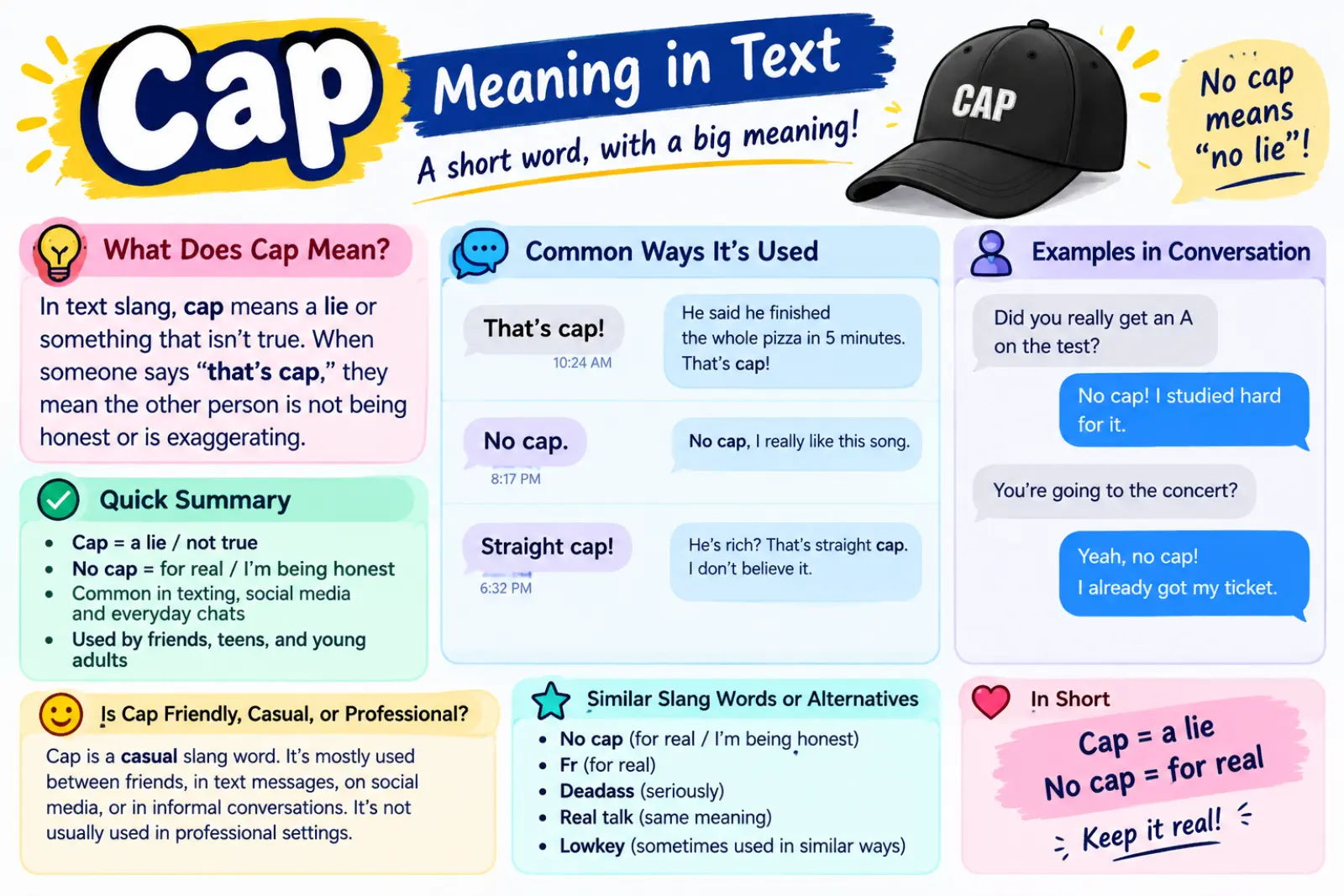
In text slang, cap means a lie, false statement, or exaggeration.
When someone says, “You’re capping,” they usually mean, “You’re lying” or “You’re not telling the truth.”
The phrase “stop the cap” means “stop lying” or “stop exaggerating.”
Another popular phrase is “no cap.” It means “no lie,” “seriously,” or “I’m telling the truth.”
For example:
“That was the best movie ever, no cap.”
Here, the person is saying they genuinely believe the movie was excellent.
The slang can also appear as capping, capped, or no cap. The exact meaning depends on the sentence and conversation.
Quick Meaning
- Cap: A lie or exaggeration.
- Capping: Lying or exaggerating.
- Stop the cap: Stop lying.
- No cap: Honestly or without lying.
- You’re capping: You are not telling the truth.
The word is mainly used in informal communication.
Where Is Cap Used?
People commonly use cap across social media and messaging platforms. You may see it on TikTok, Instagram, Snapchat, X, Facebook, Discord, and other online communities.
It is also common in text messages between friends.
You may notice it in:
- Text messages
- TikTok comments
- Instagram comments
- Snapchat chats
- YouTube comments
- Gaming chats
- Discord conversations
- Memes
- Casual social media posts
Younger internet users often use the term, but it is not limited to teenagers. Many adults also understand and use it in casual online conversations.
The slang became especially popular through internet culture and social media. Its meaning is usually easy to understand from context.
For example, if someone says, “I got 100% on every test this year,” and another person replies, “Cap 😂,” they are suggesting that the statement sounds untrue.
Examples of Cap in Conversation
Here are some realistic examples showing how cap works in everyday chats.
Example 1: Calling Out a Lie
Alex: I ran five miles before breakfast today.
Sam: Cap 😂
Sam thinks Alex is exaggerating or lying.
Example 2: Saying Something Is True
Mia: This restaurant has the best burgers.
Liam: No cap, they really do.
Here, no cap means Liam genuinely agrees.
Example 3: Stop the Exaggeration
Jake: I have like 50 people waiting to talk to me.
Chris: Bro, stop the cap.
Chris thinks Jake is exaggerating.
Example 4: Funny Conversation
Sara: I never check my phone during class.
Emma: Girl, that’s cap. 😭
Emma jokingly says Sara is not being truthful.
Example 5: Friendly Agreement
Tom: That game was amazing.
Ryan: No cap! I could play it all night.
Ryan strongly agrees with Tom.
Example 6: Social Media Comment
Post: “I woke up looking this perfect.”
Comment: “Cap 😂”
The commenter is joking that the person is exaggerating.
Example 7: Flirty Conversation
A: You looked really good today.
B: No cap? 👀
A: No cap. You really did.
Here, no cap simply emphasizes honesty. The romantic tone comes from the conversation, not from the word itself.
When to Use and When Not to Use Cap
Cap is best for relaxed conversations.
You can use it when chatting with friends or commenting on social media. It also works well in memes, gaming chats, and casual group conversations.
Good Situations for Cap
Use cap when:
- You are joking with friends.
- Someone makes an exaggerated claim.
- You want to say something is true.
- You are commenting casually online.
- You are talking in a gaming or social group.
For example:
“No cap, that was hilarious.”
This sounds natural in casual texting.
When Not to Use Cap
Avoid slang like cap in formal communication.
For example, it may sound inappropriate in:
- Job applications
- Business emails
- Formal reports
- Academic assignments
- Official requests
- Professional presentations
Instead of saying, “That’s cap,” in a formal setting, say:
“That does not seem accurate.”
The right choice depends on your audience.
What Does “No Cap” Mean?
No cap means “I’m telling the truth” or “I’m being completely honest.”
It is often used to emphasize a statement.
For example:
“No cap, this is the best pizza I’ve ever had.”
The speaker wants you to know that they are serious.
You can think of no cap as similar to:
- Honestly
- Seriously
- For real
- No lie
- I’m not joking
The phrase is usually casual and expressive.
What Does “Stop the Cap” Mean?
“Stop the cap” means “stop lying” or “stop exaggerating.”
Someone may say it when they do not believe another person’s claim.
For example:
“I can beat anyone at this game.”
“Stop the cap!”
The response suggests that the speaker does not believe the claim.
Depending on the relationship, it can sound playful or confrontational.
Is Cap Friendly, Casual, or Flirty?
The word cap is mainly casual slang.
It is not automatically rude. However, calling someone a liar can sometimes sound insulting.
For example:
“Cap 😂”
may be playful between friends.
But:
“You’re capping.”
could sound more serious during an argument.
Cap does not have a specific flirty meaning. However, people can use it during a flirty conversation.
For example:
“You think I’m cute?”
“No cap 😉.”
Here, the flirty feeling comes from the context.
Similar Slang Words or Alternatives
Several slang terms can express ideas similar to cap.
| Slang | Meaning |
|---|---|
| No cap | Honestly or seriously |
| For real (FR) | Truly or genuinely |
| No lie | I am telling the truth |
| Facts | Strong agreement |
| Fake | Not genuine or truthful |
These words are all informal, but they are not always interchangeable.
For example, “facts” usually shows agreement, while “cap” challenges someone’s statement.
What Does Cap Mean From a Girl?
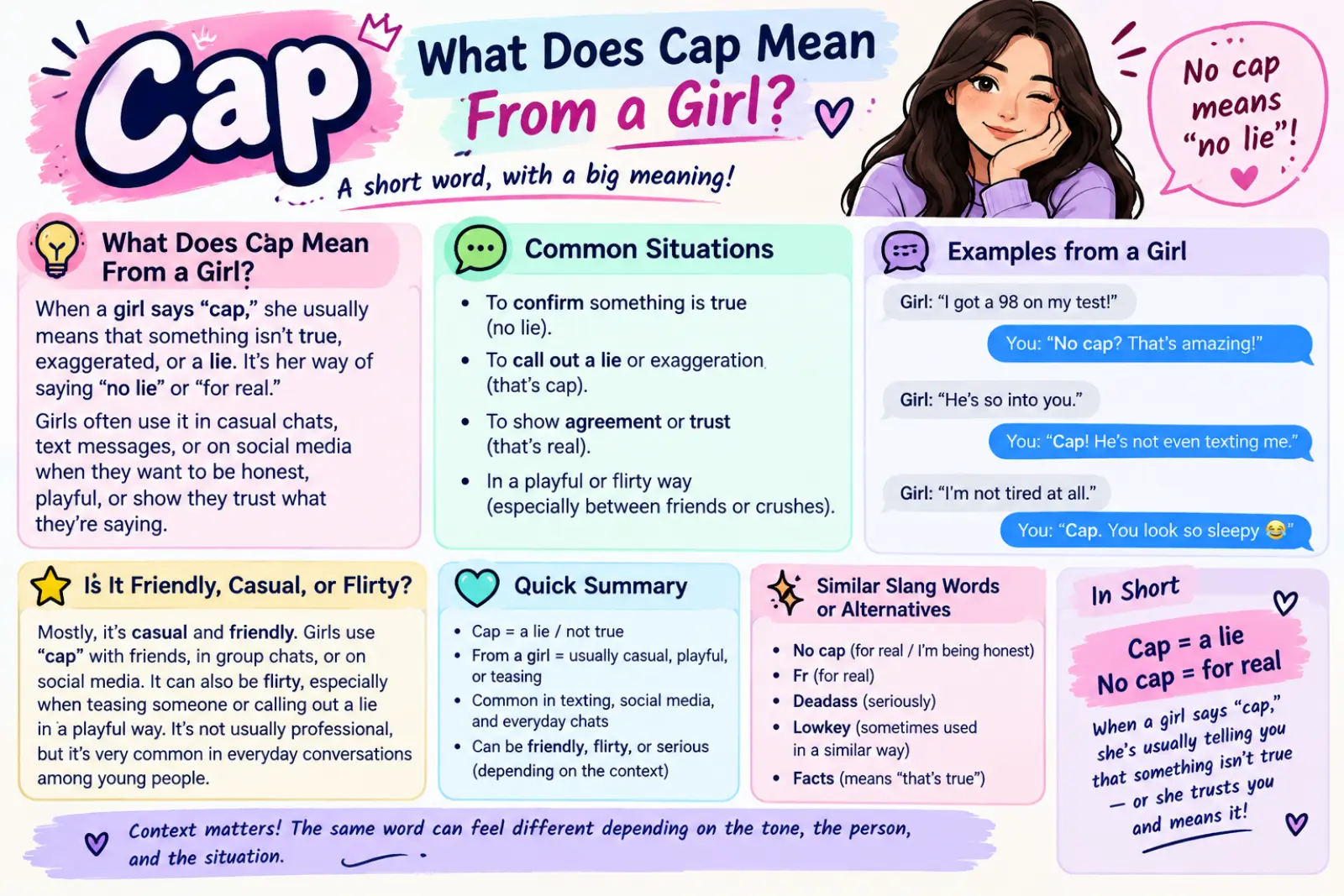
If a girl says “cap,” she usually means that she thinks someone is lying or exaggerating.
For example:
“I finished the whole project in ten minutes.”
“Cap 😂.”
She is saying she does not believe the claim.
The meaning does not change simply because a girl uses it.
Is Cap Slang Rude?
Cap is not automatically rude.
Friends often use it jokingly. However, saying someone is lying can sound rude if the conversation is serious.
Your tone and relationship matter.
A laughing emoji can make the phrase feel more playful, while a serious argument can make it sound confrontational.
Can I Use Cap in Professional Chats?
It is better to avoid cap in professional chats.
Slang can make your message sound too casual or unclear.
Instead of:
“That’s cap.”
you could say:
“I don’t think that information is correct.”
This sounds clearer and more professional.
Does Cap Have a Flirty Meaning?
Cap does not have a standard flirty meaning.
Someone may use it during flirting, but the slang itself is about truth, lies, or exaggeration.
For example:
“You’re the cutest person here.”
“No cap?”
“No cap 😉.”
The flirting comes from the compliment and conversation.
Is Cap Still Popular in 2026?
Yes, cap and no cap remain recognizable internet slang, especially in casual social media conversations and texting.
However, slang changes quickly. Some expressions become more popular while others fade over time.
The safest approach is to understand the context rather than forcing slang into every conversation.
FAQs:
What does cap mean in slang?
Cap means a lie, false statement, or exaggeration.
What does no cap mean?
No cap means honestly, seriously, or without lying.
What does “stop the cap” mean?
It means “stop lying” or “stop exaggerating.”
Is cap a bad word?
No. Cap is not a swear word, but calling someone a liar can sound rude depending on the situation.
Can I use cap at work?
It is better to avoid it in formal or professional communication. Use clear language instead.
Conclusion
The cap meaning slang is simple once you know the context. In texting and social media, cap usually means a lie, exaggeration, or something that is not true. If someone says “you’re capping,” they think you are lying. If they say “no cap,” they mean they are being honest. The slang is casual and works best in texts, social media, gaming chats, and conversations with friends. It does not have a fixed flirty meaning, although it can appear in playful or romantic chats. When using cap, always consider your audience. If the conversation is formal, choose clear and professional words instead.

Rubab Fatima is a passionate content writer and researcher with a strong interest in meanings, symbolism, language, and educational topics. She enjoys creating clear, informative, and engaging content that helps readers better understand words, concepts, and their deeper significance. Through her work at MeaningMindz.com, Rubab focuses on delivering well-researched articles that are both accurate and easy to read. Her goal is to make learning enjoyable while providing valuable insights that readers can trust.



1 thought on “Cap Meaning Slang 💬”