Have you ever seen someone write “BOGO deal” in a text message, TikTok video, or Instagram post and wondered what it means?
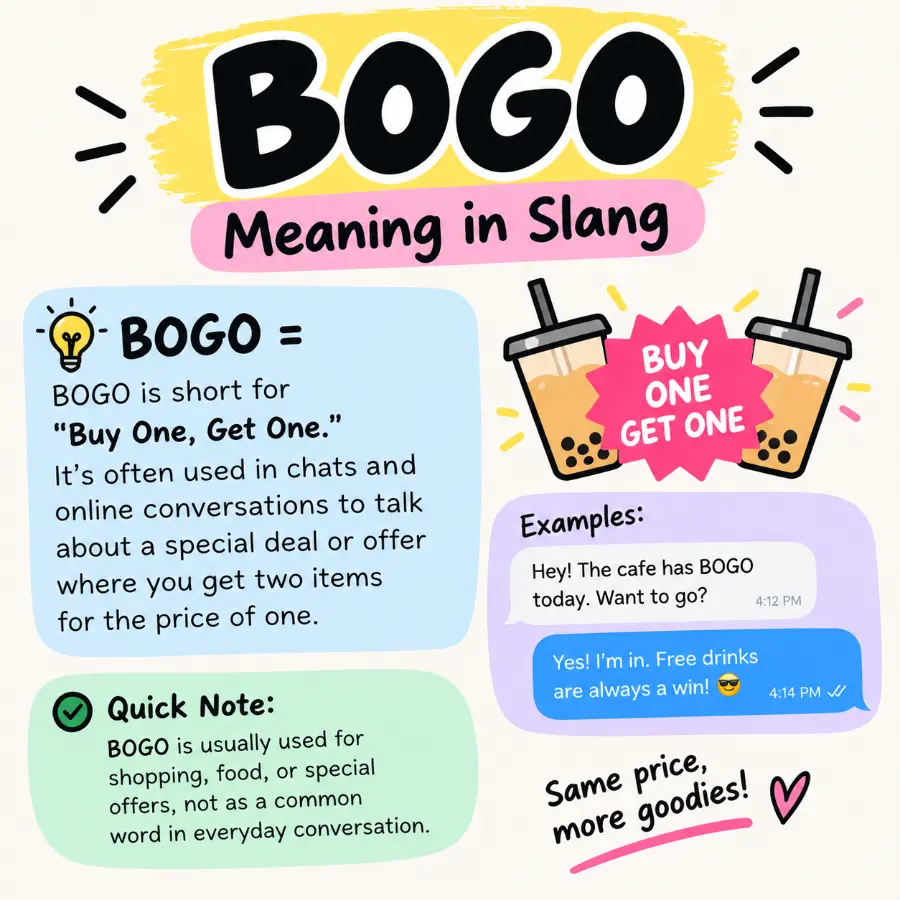
You are not alone! Internet slang and abbreviations can sometimes feel confusing, especially when a few letters have a specific meaning. BOGO usually stands for “Buy One, Get One.” People commonly use it when talking about shopping deals, discounts, and special offers.
Although BOGO is not traditional texting slang, it often appears in casual conversations and social media captions. Understanding this abbreviation can help you follow online shopping trends, understand advertisements, and reply confidently when friends mention a great deal.
What Does BOGO Mean in Text?
BOGO means “Buy One, Get One.” It describes a special offer where you buy one item and receive another item as part of the promotion.
For example, if a store advertises a BOGO deal on shoes, you might buy one pair and receive another pair for free or at a discounted price.
The exact offer depends on the store’s rules. BOGO does not always mean the second item is free.
Common BOGO Variations
Here are some common forms you may see online:
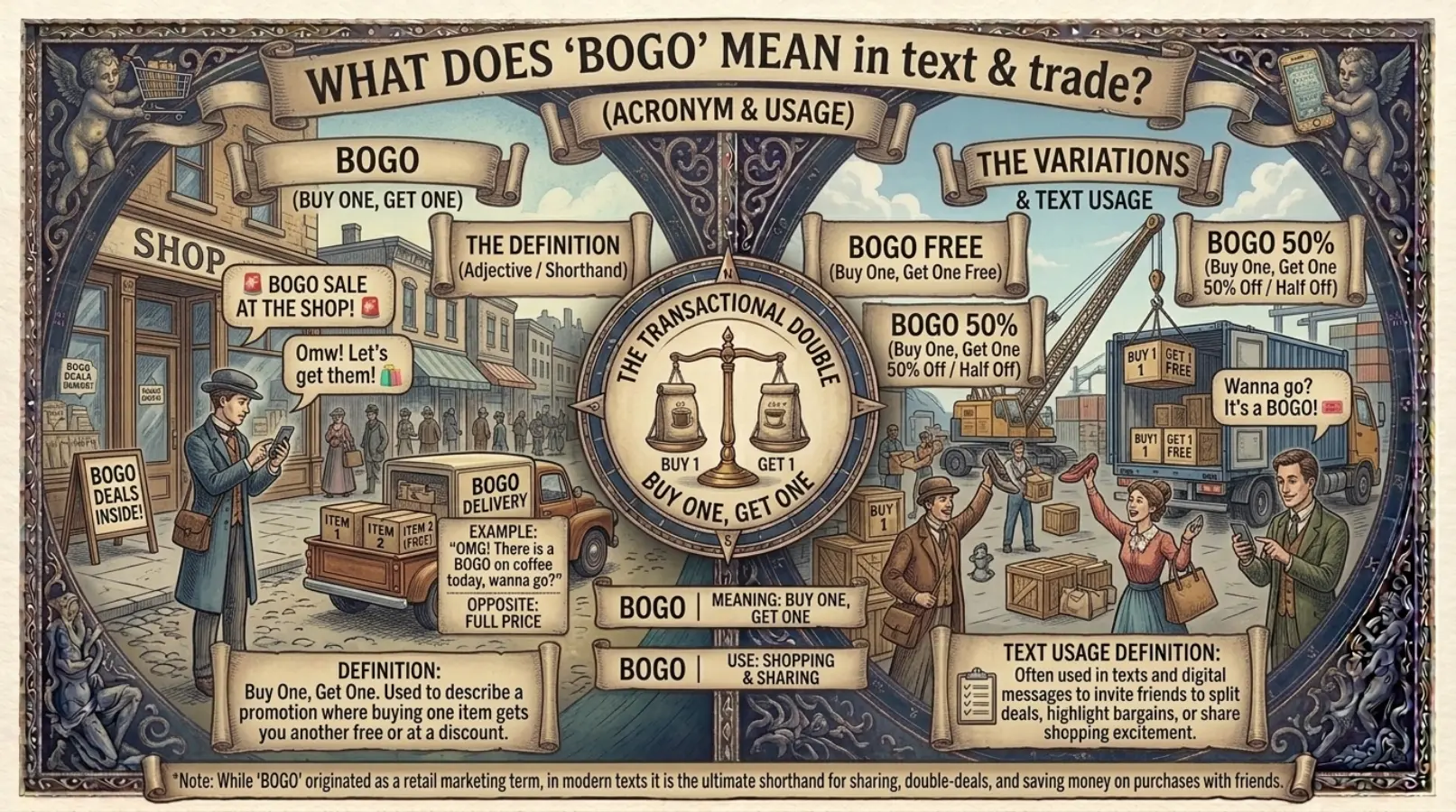
- BOGO: Buy One, Get One. The second item may be free or discounted, depending on the offer.
- BOGO Free: Buy one item and get another eligible item free.
- BOGO 50% Off: Buy one item and get the second eligible item at 50% off.
- BOGO Deal: A general phrase for a buy-one-get-one promotion.
In everyday conversations, people may use BOGO as a quick way to share a bargain or recommend a store.
Example:
Friend 1: “This store has a BOGO deal on hoodies!”
Friend 2: “Really? Let’s go shopping!”
Here, BOGO tells the other person that the store is offering a special deal.
Where Is BOGO Used?
BOGO appears in shopping-related conversations, advertisements, social media posts, and online stores. It is widely understood by shoppers and general internet users.
1. Text Messages
Friends often use BOGO when sharing discounts or planning a shopping trip.
Example: “The pizza place has a BOGO offer tonight.”
2. Instagram
Brands and influencers use BOGO in promotional posts, stories, and captions.
Example: “Weekend shopping! Grab our BOGO offer before it ends.”
3. TikTok
TikTok creators may mention BOGO deals in shopping hauls, product reviews, and discount videos.
Example: “Here’s how I saved money using a BOGO deal!”
4. Snapchat
People may send snaps about food offers, clothing sales, or beauty products.
Example: “BOGO drinks after school? I’m in!”
5. Online Shopping Websites
Retailers often display BOGO promotions on product pages, banners, and sale sections.
You might see these offers on clothing, cosmetics, snacks, household products, and more.
Is BOGO Popular Among Teens?
BOGO is not limited to teenagers. Students, adults, shoppers, and businesses use it. It is especially common in retail and marketing because it communicates a promotion quickly.
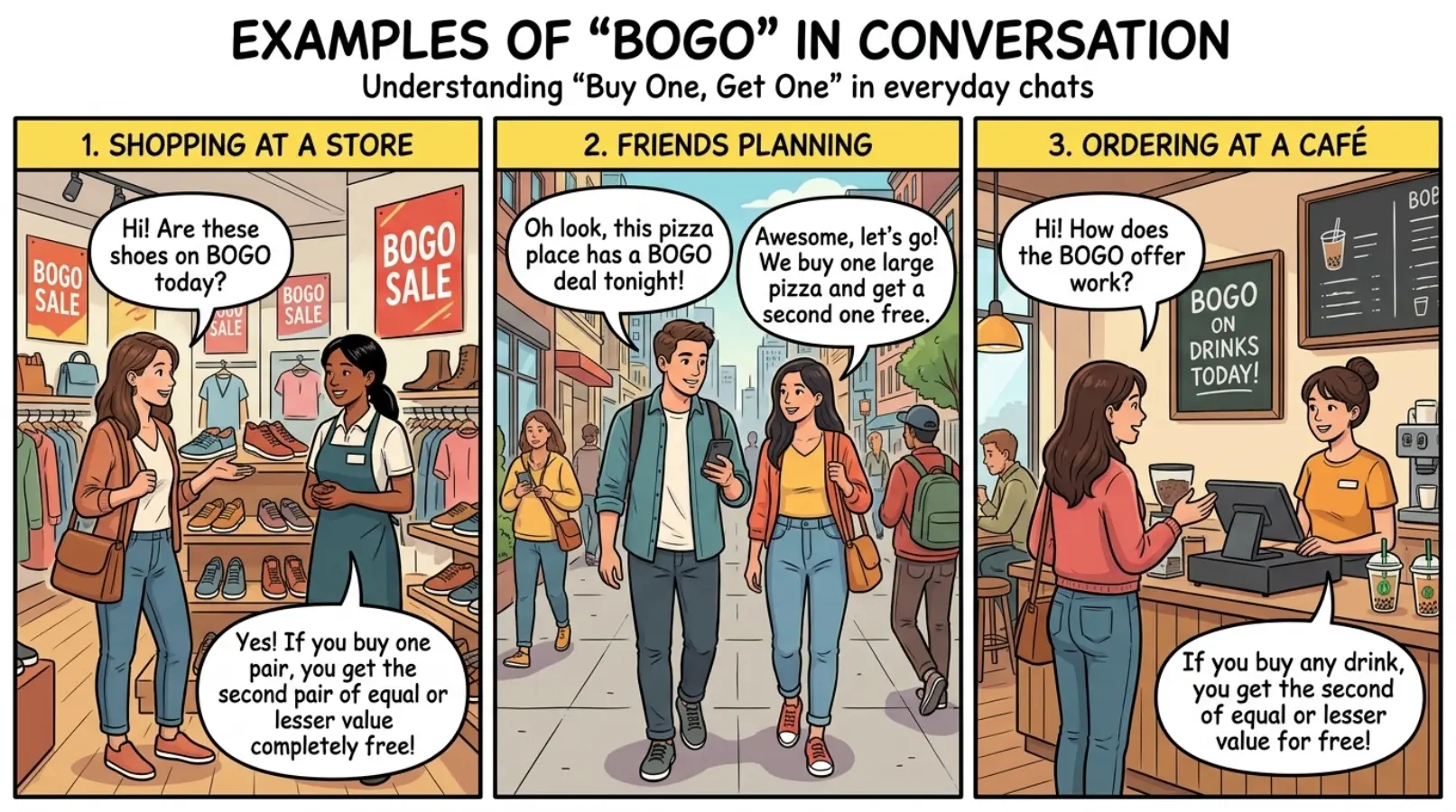
Examples of BOGO in Conversation
These realistic examples show how people use BOGO in everyday chats.
Example 1: Friendly Conversation
Person 1: “I found a BOGO deal on my favorite snacks.”
Person 2: “That’s perfect! Buy some for me too.”
Meaning: One friend shares a shopping offer with another.
Example 2: Shopping With Friends
Person 1: “The shoe store has a BOGO sale today.”
Person 2: “Let’s check it out after lunch.”
Meaning: They want to take advantage of a special promotion.
Example 3: Funny Conversation
Person 1: “Why did you buy six burgers?”
Person 2: “BOGO deal. I couldn’t ignore it!”
Meaning: The person bought extra food because of the promotion.
Example 4: Instagram Caption
Person 1: “New makeup haul! BOGO deals are my weakness.”
Person 2: “You always find the best bargains!”
Meaning: The person enjoys shopping discounts.
Example 5: Casual Food Chat
Person 1: “Want to order pizza tonight?”
Person 2: “Only if we find a BOGO offer!”
Meaning: They want to save money on their food order.
Example 6: Flirty Conversation
Person 1: “There’s a BOGO deal on ice cream.”
Person 2: “Great! One for you and one for me. Date night? 😉”
Meaning: The person playfully suggests sharing ice cream and spending time together. The flirty meaning comes from the context, not from BOGO itself.
Example 7: Family Chat
Person 1: “The supermarket has a BOGO deal on cereal.”
Person 2: “Nice! Get two boxes if the offer is worth it.”
Meaning: They discuss a practical shopping opportunity.
When to Use and When Not to Use BOGO
BOGO is easy to use when you are talking about shopping, sales, and discounts. However, it may not fit every situation.
When to Use BOGO
Use BOGO when:
- Sharing a buy-one-get-one promotion with friends.
- Posting about a shopping bargain on social media.
- Discussing food, clothes, cosmetics, or other retail offers.
- Asking someone to join you for a shopping trip.
- Writing a short promotional caption for a suitable audience.
Example: “Check this store today. It has a BOGO deal on skincare!”
When Not to Use BOGO
Avoid using BOGO without explanation when your audience may not recognize the abbreviation.
It may also be unsuitable in formal writing if the reader expects full, clear wording.
For example, instead of writing “BOGO offer available” in a formal business report, write “A buy-one-get-one promotion is available.”
Is BOGO Professional?
BOGO is acceptable in retail marketing, advertising, and workplace conversations about promotions. However, it may be too informal for some academic assignments or formal reports.
For professional communication, explain the offer clearly and include its conditions.
Remember that some promotions require purchasing items of equal or lesser value, while others have different restrictions. Always check the terms before promising that an item is free.
Similar Slang Words or Alternatives
If you are learning internet abbreviations, these related terms may also be useful.
- B1G1: A shortened version of “Buy One, Get One,” commonly used in promotions.
- BOGOF: “Buy One, Get One Free.” This specifically indicates that the second eligible item is free.
- OMG: “Oh My God.” Used to express surprise or excitement.
- FYI: “For Your Information.” Used to share helpful information.
- TBH: “To Be Honest.” Used to introduce an honest opinion.
BOGO and BOGOF are closely related, but they are not always interchangeable. BOGO can describe several types of promotions, while BOGOF specifically refers to getting the second item free.
FAQs:
1. What does BOGO mean from a girl?
BOGO usually means “Buy One, Get One” when a girl uses it in a message. She may be sharing a shopping deal, suggesting a food offer, or telling you about a discount. It does not automatically have a romantic meaning.
2. Is BOGO slang rude?
No, BOGO is not generally rude or offensive. It is a common abbreviation used in shopping and marketing. Its meaning depends on the conversation, but it normally refers to a promotion.
3. Can I use BOGO in professional chats?
Yes. BOGO is suitable for many retail, sales, and marketing conversations. In formal documents or messages to unfamiliar audiences, write out “buy one, get one” to avoid confusion.
4. Does BOGO have a flirty meaning?
BOGO has no widely established flirty meaning. Someone might use it jokingly while inviting you to share food or go shopping, but the flirtation comes from the surrounding message.
5. Is BOGO still popular in 2026?
BOGO remains a familiar abbreviation in retail promotions and shopping conversations. Its use is connected more closely to sales and discounts than to a specific social media trend.
6. Does BOGO always mean the second item is free?
No. A BOGO offer may provide a free second item, a discounted second item, or another deal defined by the seller. Read the promotion’s terms to understand exactly what you receive.
Conclusion
BOGO means “Buy One, Get One.” It is a common abbreviation used in shopping promotions, text messages, social media posts, and online advertisements. People use it to share bargains on food, clothes, beauty products, and many other items.
Although BOGO sometimes appears in casual chats, it is not usually personal or flirty slang. Its meaning is generally related to shopping and saving money. The easiest way to understand it is to look at the surrounding conversation and check the offer’s details.
Next time a friend messages you about a BOGO deal, you will know what they mean. You can even reply, “Sounds great! Let’s check the offer!”

Rubab Fatima is a passionate content writer and researcher with a strong interest in meanings, symbolism, language, and educational topics. She enjoys creating clear, informative, and engaging content that helps readers better understand words, concepts, and their deeper significance. Through her work at MeaningMindz.com, Rubab focuses on delivering well-researched articles that are both accurate and easy to read. Her goal is to make learning enjoyable while providing valuable insights that readers can trust.






1 thought on “BOGO Slang Meaning on TikTok, Snapchat, and Instagram”