Have you ever received a message that simply says “OK” and wondered what the person really meant? You are not alone.
A short “OK” can feel friendly, neutral, annoyed, or even a little cold, depending on the conversation. In texting, people often use OK because it is quick and easy. However, its meaning can change with punctuation, emojis, and the situation.
Someone might type “OK 😊” to show agreement, while “OK.” may sound more serious. In this guide, we will explain the OK meaning in text, where people use it, what it can mean from different people, and how to understand its tone.
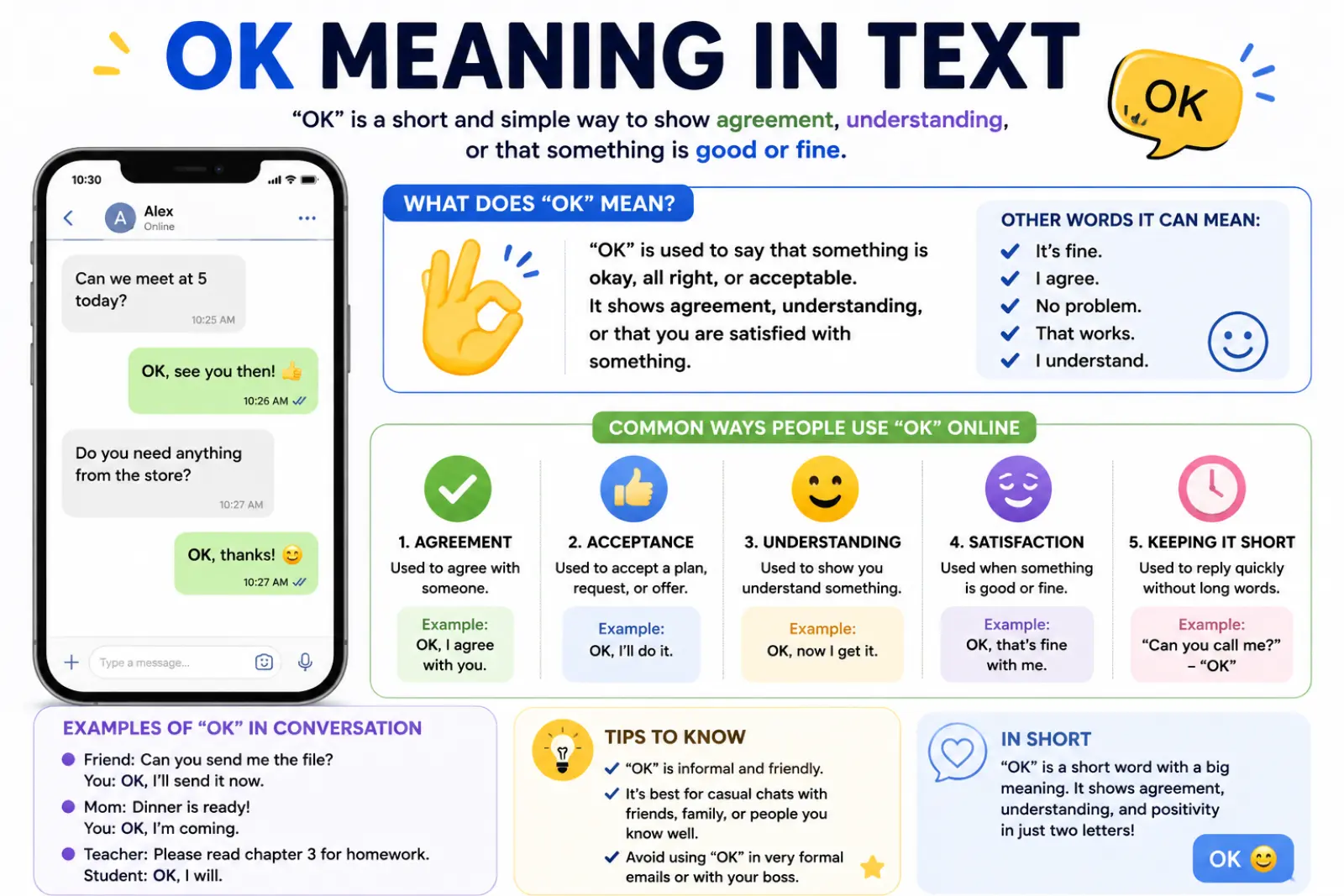
What Does OK Mean in Text?
The most common meaning of OK in text is “okay.”
It usually means:
- I agree.
- I understand.
- That is fine.
- Yes, I accept.
- I acknowledge your message.
- Everything is all right.
For example:
Person 1: “I’ll call you after dinner.”
Person 2: “OK.”
Here, OK simply means the person understands and agrees.
“OK” is not usually considered slang. It is a very common everyday expression used in texting, social media, emails, and face-to-face conversations.
Does OK Have Different Meanings?
Yes. The meaning can change depending on the situation and tone.
| Text | Possible meaning |
|---|---|
| OK | Agreement or acknowledgment |
| Okay | Friendly or neutral agreement |
| OK! | Enthusiastic agreement |
| OK 😊 | Friendly acceptance |
| OK lol | Lighthearted response |
| OK? | Asking for confirmation |
| OK… | Doubt, hesitation, or discomfort |
| OK. | Could sound serious or cold |
Therefore, you should consider the whole conversation instead of focusing only on the word.
Where Is OK Used?
OK is used almost everywhere people communicate online.
You may see it in:
- Text messages
- Instagram DMs
- Snapchat
- TikTok comments
- Facebook Messenger
- Discord
- Gaming chats
- Online forums
- Emails
- Everyday conversations
Unlike many internet abbreviations, OK is used by people of almost every age group. It is not limited to teenagers, gamers, or younger social media users.
People often choose “OK” because it saves time and clearly acknowledges a message.
For example:
Friend: “Meet me at 7 tonight.”
You: “OK!”
This shows that you received and accepted the plan.
Examples of OK in Conversation
Here are several realistic examples showing how OK can appear in text.
1. Simple agreement
Alex: “Can we meet tomorrow?”
Sam: “OK.”
Meaning: Sam agrees to the meeting.
2. Friendly response
Mia: “I saved you some cake!”
Lena: “OK 😊 Thank you!”
Here, the emoji makes the message feel warmer and friendlier.
3. Confirming information
Dad: “Please pick up some milk.”
Son: “OK, I will.”
Meaning: The person understands the request.
4. Casual response
Jake: “I’m running ten minutes late.”
Tom: “OK, no problem.”
Here, “OK” shows acceptance.
5. Flirty conversation
Emma: “You looked really good today.”
Ryan: “OK, now you’re making me blush 😂”
Here, “OK” does not have a special flirty meaning. The surrounding conversation creates the playful tone.
6. Possible annoyance
Person 1: “I already told you three times.”
Person 2: “OK.”
This short response could sound irritated or dismissive, depending on the relationship.
7. Asking for confirmation
A: “You are coming with us, OK?”
B: “OK!”
Here, “OK” means agreement and confirmation.
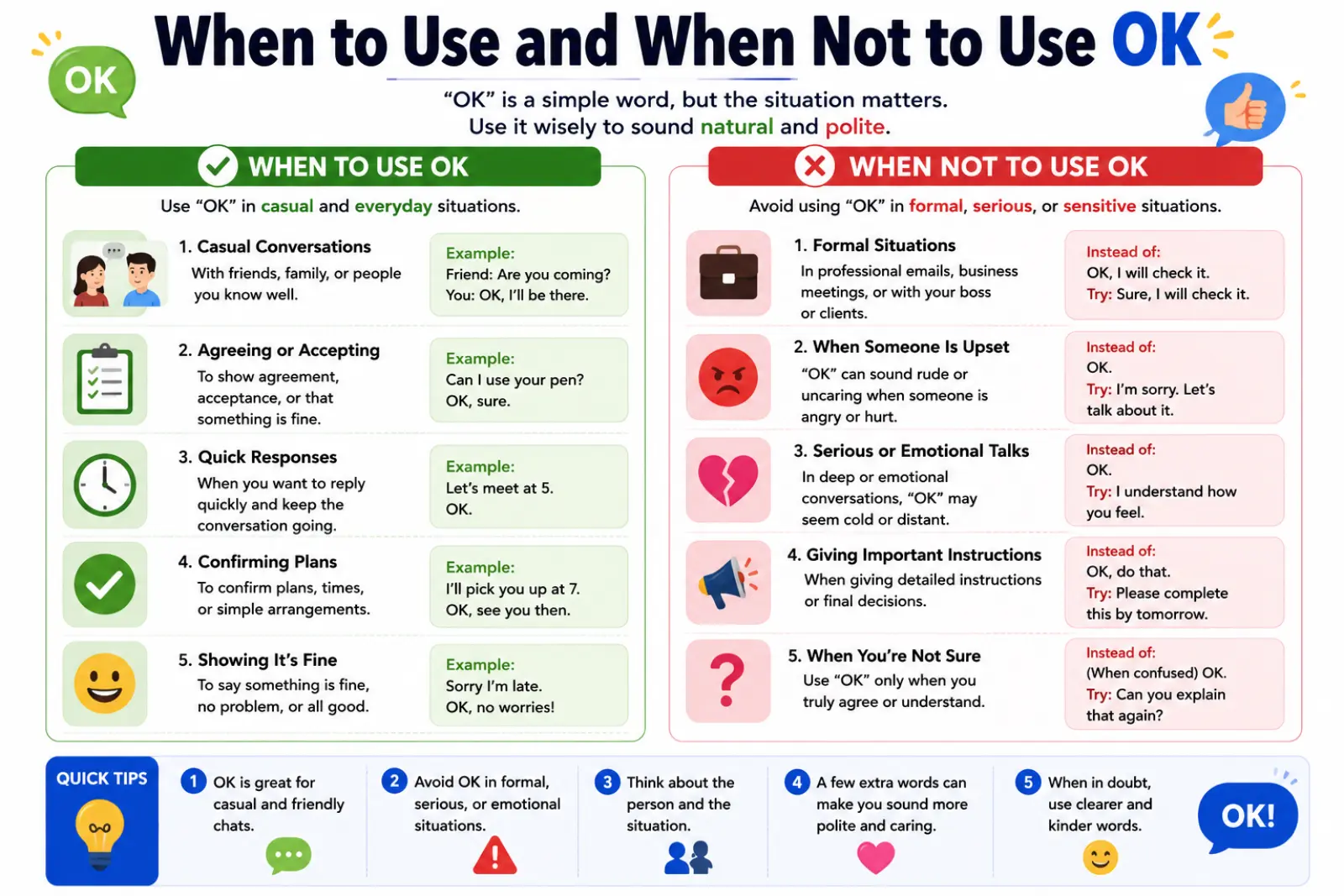
When to Use and When Not to Use OK
OK is generally safe and appropriate for casual communication.
When You Can Use OK
Use it when:
- You want to acknowledge a message.
- You agree with someone.
- You understand instructions.
- You accept a plan.
- You want a quick response.
- You are chatting with friends or family.
For example:
Friend: “I’ll send the address later.”
You: “OK, thanks!”
When You Should Be Careful
A one-word “OK” can sometimes sound cold or uninterested.
For example:
Friend: “I’m really sorry about what happened.”
You: “OK.”
This may sound dismissive because the situation requires more emotional support.
Instead, you could say:
“It’s OK. Thanks for apologizing.”
You should also avoid overly casual responses when a more professional reply is expected.
In a workplace message, instead of only writing:
“OK.”
you might write:
“Okay, thanks. I’ll take care of it.”
That sounds clearer and more professional.
Is “OK” Friendly or Rude?
Usually, OK is neutral, not rude.
However, the tone depends heavily on context.
Compare these messages:
“OK 😊” — friendly
“OK, thanks!” — polite
“OK!” — positive or enthusiastic
“OK…” — uncertain or uncomfortable
“OK.” — potentially serious or cold
“k” — can sometimes feel dismissive
The relationship between the people also matters. A close friend may send “OK” without any negative intention.
Does OK Have a Flirty Meaning?
OK does not normally have a specific flirty meaning.
However, someone can use it during a flirty conversation. The flirtation usually comes from the surrounding words, emojis, or context.
For example:
“OK 😏 I see what you’re doing.”
The emoji and wording create the playful tone. The word “OK” itself is not inherently flirty.
So, if someone sends you “OK,” do not automatically assume they are flirting.
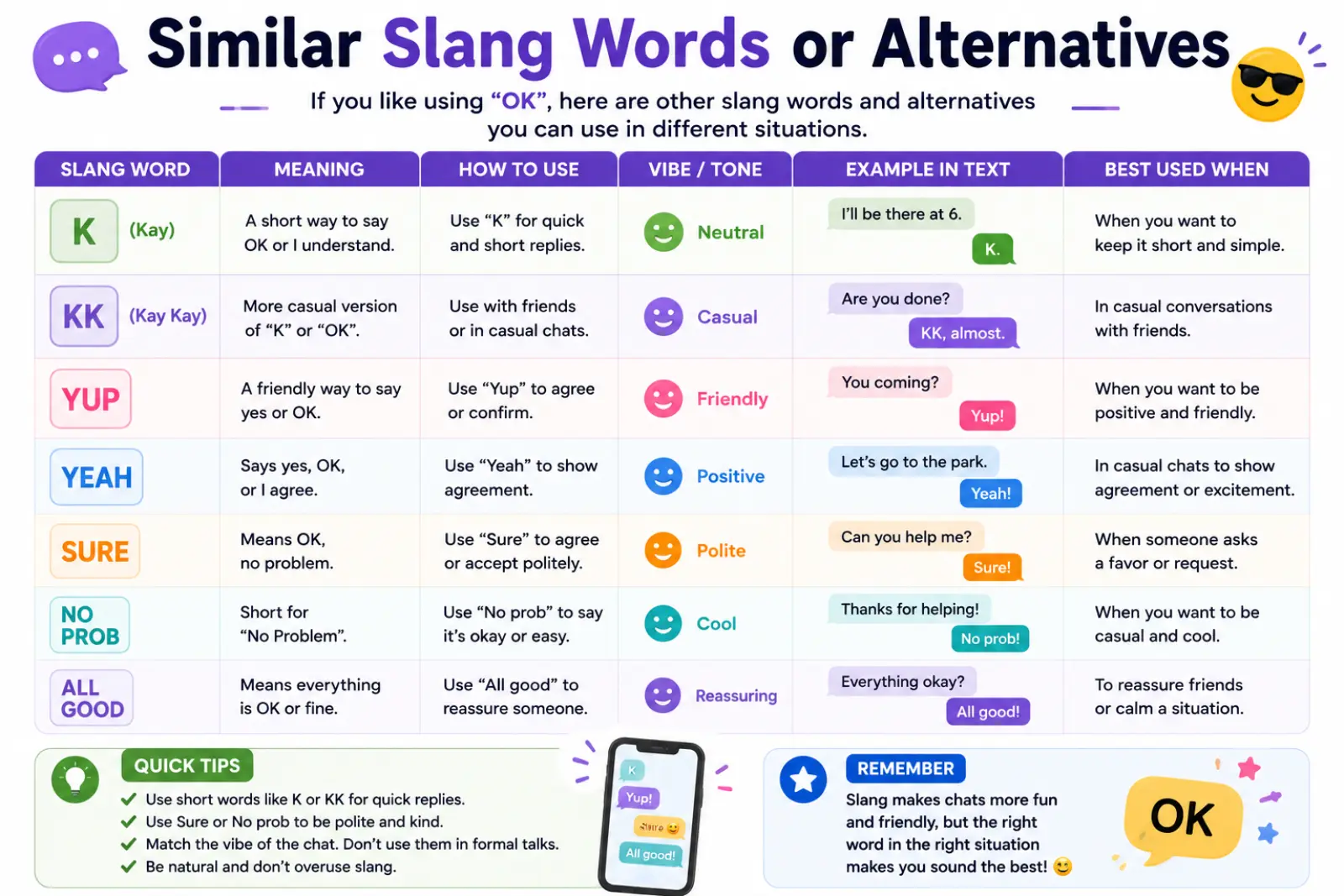
Similar Slang Words or Alternatives
Several short expressions can replace OK in casual texting.
1. K
A shortened form of “OK.” It is very casual and can sometimes sound cold.
2. Alright
Means that you agree or accept something.
3. Sure
Shows agreement or willingness.
4. Got it
Means you understand the information.
5. Yep
An informal way to say “yes.”
6. Sounds good
Shows that you agree with a suggestion or plan.
For example:
“Let’s meet at 6.”
“Sounds good!”
This often feels warmer than simply saying “OK.”
FAQs:
What does OK mean from a girl?
Usually, OK means okay, I understand, or I agree. It does not automatically have a romantic or negative meaning. Context matters.
Is OK slang rude?
No. OK is generally neutral and polite enough for everyday communication. However, a very short “OK.” can sometimes feel cold or dismissive.
Can I use OK in professional chats?
Yes. “OK” can work in casual workplace communication. For formal messages, a clearer response such as “Understood” or “Thank you, I’ll handle it” may sound more professional.
Does OK have a flirty meaning?
Not by itself. OK has no standard flirty meaning. A flirty tone comes from the surrounding conversation, wording, or emojis.
Is OK still popular in 2026?
Yes. OK remains a widely understood expression in texting and everyday communication. It is much more established than many short-lived internet slang terms.
Conclusion
The OK meaning in text is usually simple: okay, I agree, I understand, or that is fine. It is one of the most common expressions used in texting and online conversations. Still, its tone can change depending on punctuation, emojis, and the situation. “OK 😊” may feel warm, while “OK.” can sometimes sound serious or distant. Remember that OK itself is not normally rude or flirty. If you are unsure about someone’s intention, look at the rest of the conversation before interpreting the message. When chatting casually, “OK” is a simple and useful response that most people understand immediately.

Rubab Fatima is a passionate content writer and researcher with a strong interest in meanings, symbolism, language, and educational topics. She enjoys creating clear, informative, and engaging content that helps readers better understand words, concepts, and their deeper significance. Through her work at MeaningMindz.com, Rubab focuses on delivering well-researched articles that are both accurate and easy to read. Her goal is to make learning enjoyable while providing valuable insights that readers can trust.





1 thought on “What Does OK Mean in a Text Message? Explained Simply”